Iran's Invisible Commandos.
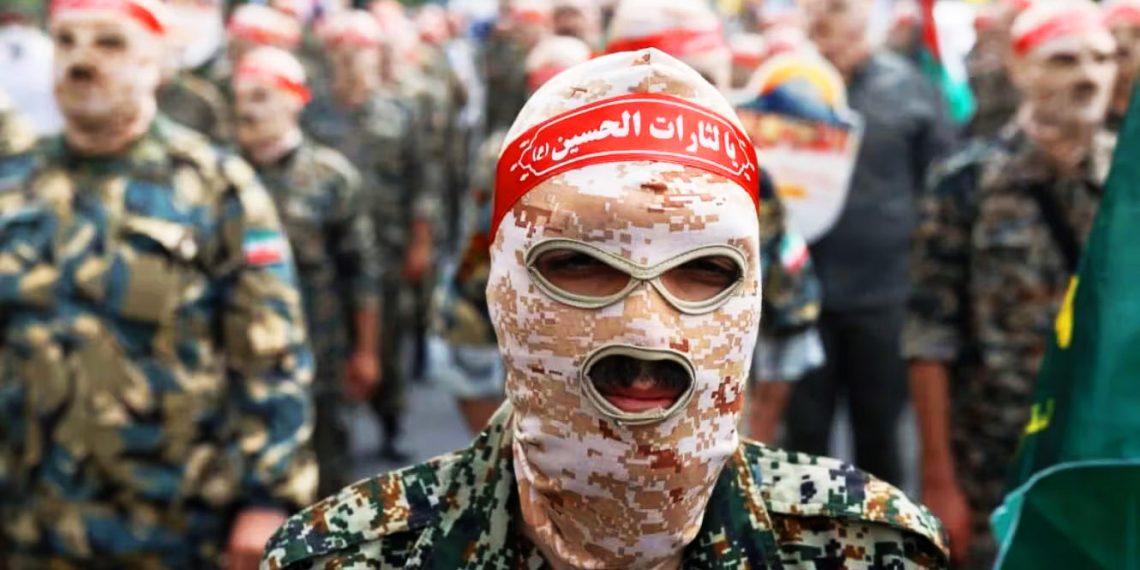
For years, when Iran's military capabilities come to light in the international media, the conversation boils down to a single name: the Quds Force.For years, when Iran's military capabilities come to light in the international media, the conversation boils down to a single name: the Quds Force. It is a familiar, visible and convenient perspective for narratives about regional reach Tehran's . But that focus hides something more immediate and relevant when the debate moves from long-term influence to short-term confrontation.It is a familiar, visible and convenient perspective for narratives about regional reach Tehran's . But that focus hides something more immediate and relevant when the debate moves from long-term influence to short-term confrontation.
If a limited attack were to occur on an island, port, or critical infrastructure, the Quds Force would not be the first to arrive. The units that would respond and determine the outcome in the first few hours are much less known. And this is not because they do not exist, but because the Islamic Republic system was never built around a single elite formation.
Instead, what exists is a stratified structure, spread across multiple institutions, where “special forces” are not a brand, but a function.
A distributed model of force
At the center of this structure is the Islamic Revolutionary Guard Corps (IRGC), particularly its ground forces. Within it, the term that appears most frequently—and is often misinterpreted—is Saberin . It is sometimes described as a unit, but that only reflects part of the truth.
In practice, it functions more like a category: a set of special operations capabilities spread across different formations.
These units are trained for raids, helicopter insertions and operations in difficult terrain. More importantly, they are integrated into Iran's provincial structure. Previous defense assessments indicate that Saberin-type units operate at the regional corps level, rotating between operational zones: in the northwest against Kurdish militant groups and in the southeast against insurgent networks.
That detail is important. It means that Iran's elite capabilities are not centralized in one place, waiting to be deployed. They are already distributed throughout the territory, adapted to local environments and accustomed to operating in fragmented and low-intensity conflicts.
This model is very different from that of Western special forces, which are typically designed for projection: arriving by plane, executing a mission, and leaving. The Iranian system is designed for presence.
Along with Saberin, there are identifiable formations within the IRGC ground forces, such as the Salman Farsi Brigade in the southeast or other special brigades that appear in exercises and in internal reports. Their public visibility remains limited, but their role is clear: they operate between local security forces and high-level strategic units, reinforcing weak points and responding to sudden threats.
Beyond the IRGC
Iran's ability to conduct special operations goes beyond the Islamic Revolutionary Guard Corps.
Within the regular army, the Artesh, a different tradition persists: older, more conventional, but still current. The most prominent unit is the 65th Special Forces Airborne Brigade, known as NOHED. Unlike the Islamic Revolutionary Guard formations, NOHED is more like classic special forces: capable of airborne operations, reconnaissance and direct action training, and rapid deployment capabilities.
What makes NOHED particularly interesting is not only its training, but also its limited operational experience abroad. Reports of its deployment to Syria in 2016 suggest that, under certain conditions, even Iran's most conventional forces can be used in expeditionary missions.
However, focusing solely on ground forces would miss a critical part of the picture.
The maritime edge
Iran's special operations capabilities are most evident in the maritime domain. The Islamic Revolutionary Guard Corps (IRGC) Navy maintains a specialized formation known as the Sepah Naval Special Force ( SNSF ). Based on islands in the Persian Gulf, including Forur, this unit trains in combat diving, amphibious assault and boarding.
Unlike many Iranian ground units, which operate largely covertly, these naval forces have left a more obvious operational footprint. They have been involved in anti-piracy operations in the Gulf of Aden and are widely associated with Iran's ability to seize or intercept ships in the Strait of Hormuz.
This reflects a strategic reality. In a confrontation with external powers, Iran is much more likely to undertake limited and geographically confined operations, especially at sea, rather than a full-scale conventional war.
Rethinking “special forces”
This raises a deeper question in comparisons with the West.
Looking for an Iranian equivalent to SEAL Team Six or Delta Force is a mistake. The Iranian system is not designed to create a single visible elite formation. Its objective is to guarantee the existence of land, maritime and internal security forces capable of responding quickly, in a local and coordinated manner.
comes into play This is where the Basij, often overlooked but of great structural importance, . While much of the Basij focuses on mobilization and internal control, certain elements, such as Fatehin units, receive higher level training and have reportedly been deployed to external theaters such as Syria.
More importantly, Basij units are integrated into IRGC operations at a tactical level, providing reinforcements, terrain awareness and personnel. In a real scenario, they would probably be among the first to respond, not as elite commandos, but as part of a tiered defensive system that supports and amplifies the actions of more specialized units.
A system designed for continuity
Taken together, this structure begins to explain why Iran's special forces are difficult to map and compare.
They are not designed to be visible. They are not organized around a single command. They do not primarily operate on the high-profile global missions that define Western special operations.
His experience has been developed, however, in calmer areas: border conflicts, internal security operations and selective deployments in Syria and Iraq.
This experience is less spectacular, but no less important. It emphasizes adaptability, knowledge of the terrain, and the ability to operate within a larger system rather than independently.
Therefore, the response to a limited external incursion is not a single unit, but a sequence determined by proximity, capacity, and escalation.
Local IRGC and Basij elements mobilize first to secure the immediate environment, followed by Saberin-type formations acting as mobile reinforcements. In parallel, if maritime conditions require it, IRGC naval special forces are deployed to control or disrupt access to the sea, while Artesh units, such as NOHED, can be deployed as higher level reinforcements when escalation demands it.
The system works through layers: a structure designed to absorb impacts, reinforce weak points and maintain operational continuity. That's the central idea.
Iran's special operations capability remains less visible, not because it is weak or because it is exceptionally secretive. It remains hidden because it does not fit dominant narratives about what special forces should be like.
There is no single emblem, nor a singular force that symbolizes it. What exists, however, is a system that is more difficult to define and much more difficult to destabilize.